


Two trademark applications filed in 1916, DALILA and YOLANDA, are still in force at Brazil's trademark office (INPI), in the name of Souza Cruz. They are more than a hundred years old.
A date like that says nothing about when a company began. It says something else: the moment someone decided a name was worth protecting, and the decision to keep that protection going, decade after decade.
In the portfolios gathered in TrademarkIQ's Company Radar there are even older dates. The first application the INPI database associates with the Bunge group is from 1901. Unilever's is from 1903.
This is how a company's history appears in the public records, as a sequence of decisions. Protecting a name, launching a product line, entering a new category, buying a competitor. Each decision leaves an application at the INPI, and the sum of applications, year after year, draws a biography that no company wrote on purpose.
Reading those biographies required solving a problem first: at the INPI, each mark belongs to a single owner, and a large company can have dozens of them.
Chart 1
Brands that span generations
Registrations the INPI keeps in force and the first applications associated with two groups, from 1901 to 1966.
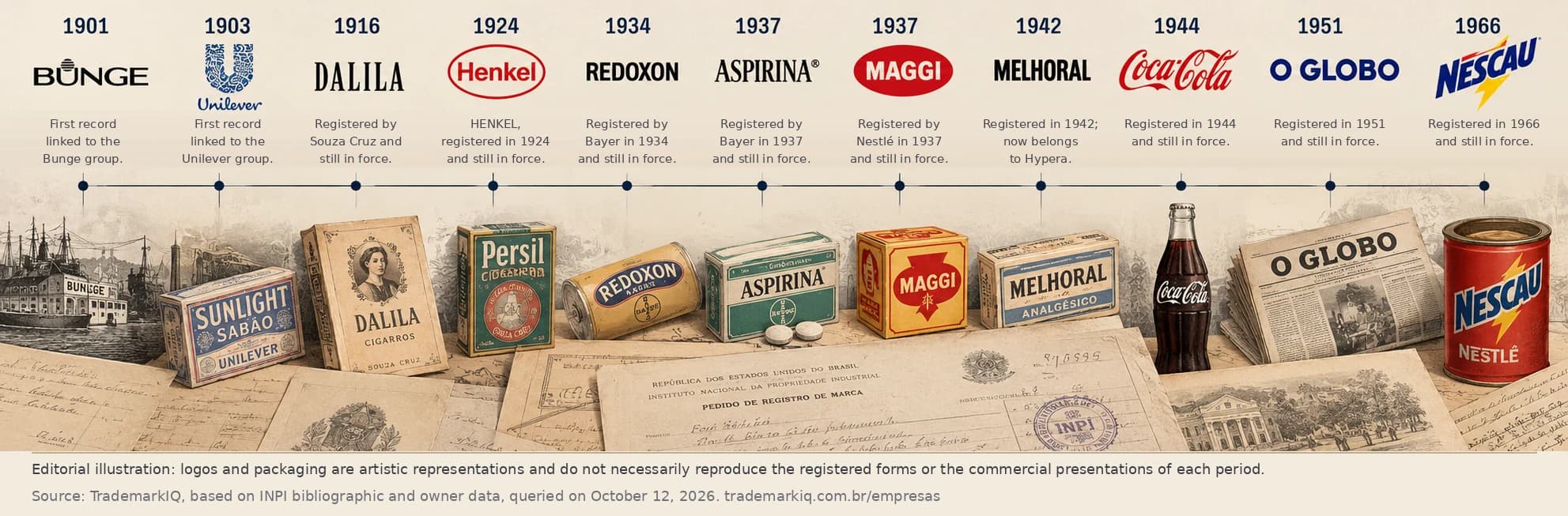
Source: TrademarkIQ, based on INPI bibliographic and owner data, queried on October 12, 2026. Editorial illustration: logos and packaging are artistic representations and do not necessarily reproduce the registered forms or the commercial presentations of each period.
The first names
Among the groups gathered in the Radar, 44 have at least one application before 1950, and 18 of them begin before 1930. The oldest dates appear in portfolios that today span several countries and activities. Bunge totals 2,743 applications through 2025. Unilever, 6,833.
Some of these old applications are still in force. DALILA, filed in 1916, remains registered in the name of Souza Cruz. Henkel has HENKEL (1924) and PERSIL (1925). At Bayer, REDOXON dates from 1934, ASPIRINA from 1937 and ALKA-SELTZER from 1938. Nestlé's MAGGI is from 1937. MELHORAL, now at Hypera, is from 1942. COCA-COLA, from 1944.
What the dates say
They do not mark when companies were founded or products launched. They mark the year of the application that still holds, and show how long someone kept renewing the right to the name.
The names that reach our homes
At the turn of the 1950s, the register begins to fill with names most Brazilians recognize. O GLOBO and CAPRICHO are from 1951, the same year as LUX. KIBON, 1952. CLAUDIA and REXONA, 1957. QUATRO RODAS and SKIP, 1959. VEJA, 1965. NESCAU, 1966.
All remain in force. Each one is, in practice, an old application that someone decided to keep alive for decades, while the country changed around it.
Globo's portfolio begins in 1951 and is today the largest among the groups analyzed, with 9,453 applications. Abril's begins in 1949 and totals 5,208. It is the same decade in which the register first shows names many people would today recognize in the newspaper, at the newsstand and on the shelf at home.
The decades of volume
From the 1970s, registrations start to multiply. CICA is from 1974 and ARISCO from 1975. The O Boticário group appears in the register in 1979. SBT and ESPORTE ESPETACULAR date from the early 1980s, MULTISHOW from 1992 and MALHAÇÃO from 1995.
Unilever's series of applications shows the change of scale. There were 85 applications in 1970, 112 in 1978 and 232 in 1987. The highest annual volume in the company's entire series in the INPI database was 1992, with 322 applications.
Chart 2
The ten largest historical portfolios
Trademark applications associated with each group, since the first application found in the INPI database.
| Corporate group | Historical applications |
|---|---|
| Globo | 9,453 |
| Unilever | 6,833 |
| Pão de Açúcar (CBD) | 5,688 |
| Nestlé | 5,427 |
| Abril | 5,208 |
| Hypera Pharma | 4,034 |
| Telefônica Brasil (Vivo) | 3,892 |
| Bayer | 3,776 |
| SBT | 3,765 |
| BRF | 3,471 |
Source: TrademarkIQ, based on INPI bibliographic and owner data, queried on October 12, 2026.
An application is not a live mark
These totals count every application ever filed, including those that never became registrations or are no longer in force. They measure a company's activity before the INPI, not the number of marks it holds today.
After the peak, each company takes its own path
The annual curve of applications shows that the companies did not follow the same trajectory. Globo filed 85 applications in 1990, 355 in 2010 and 166 in 2025.
Nestlé went from 161 applications in 2010 to 42 in 2025. O Boticário went the opposite way: 18 in 2000, 167 in 2020 and 138 in 2025. Among the group's names still in force are EUDORA (2010) and THE BEAUTY BOX (2011).
Chart 3
Three paces of protection
Trademark applications per year of filing, at five-year intervals, from 1985 to 2025.
Source: TrademarkIQ, based on INPI bibliographic and owner data, queried on October 12, 2026.
The curves do not allow concluding that a company is growing or losing relevance. The number of applications depends on protection policy, corporate structure and the products and services involved. What they show is that the pace of filing marks changes over a company's life.
From Brazil to the world
Part of these stories crosses borders. Nestlé, Bayer, Siemens, Henkel and Johnson & Johnson have marks linked to the group in more than one hundred countries. Among companies of Brazilian origin, Globo appears in 21 countries and Pão de Açúcar in 13.
The number measures in how many countries at least one mark has been identified, not the extent of protection in each. Even so, it shows how much each company took its name beyond its home market.
The history that was scattered
None of this appeared in an ordinary INPI search. Anyone searching by a company's name found only part of what it had registered, because the marks are spread across subsidiaries, merged companies and corporate names that changed over time.
The Company Radar gathers each group's owners from public records, curated by TrademarkIQ. A portfolio that was in pieces can thus be read as a trajectory, from the first application to the latest.
What the records allow us to say
In all, the portfolios of the groups now gathered in the Radar exceed 200,000 historical applications. This is a selection of large groups, not a ranking of all companies operating in Brazil.
INPI records do not tell the whole story of a company. But they hold the protection and investment decisions that, added up over decades, help explain how it built what it has. The data do not say why each decision was made.
To explore
Each company mentioned here has its own page in the Company Radar, with the timeline of applications, the heaviest marks and its presence abroad. Look for the names that were part of your life.
Open the Company RadarHow we calculated
- Universe and source
- INPI trademark database, with bibliographic and owner data, and the Federal Revenue company registry (CNPJ). Queried on October 12, 2026. International presence from public trademark databases of other countries, consolidated by TrademarkIQ.
- Historical applications
- Trademark registration applications, by filing year, associated with each group's owners. They include applications that were refused, shelved or lapsed. The date of the first application is the oldest found in the database.
- Groups
- Owners gathered from public records, curated by TrademarkIQ. The selection covers large groups operating in Brazil and does not represent the universe of Brazilian companies.
- Registrations in force
- Names cited as still in force (for example DALILA, ASPIRINA and COCA-COLA) have the status "trademark registration in force" in the database. The year given is that of the oldest living application with that name.
- International presence
- Number of countries with at least one mark linked to the group. It does not measure the number of registrations or the extent of protection in each country.
- Limitations
- The application year is not the year the company was founded or the mark launched. Marks and owners of predecessor companies may be part of current portfolios. The design does not allow inferring intent or cause for the differences in pace between companies.
Sources
- INPI, Industrial Property Gazette (RPI) and open trademark data.
- Federal Revenue Service, national company registry (CNPJ), current edition.
- Company Radar, TrademarkIQ, at trademarkiq.com.br/empresas.
Third-party names, trademarks and logos are shown to identify companies and give context to public intellectual property information. They belong to their respective owners, and their display does not indicate any affiliation, partnership or endorsement. Corrections: [email protected].
The INPI was not contacted for this edition. Material corrections will be published on this page with an update note.

Ricardo Vinhas
Founder of TrademarkIQ
Ricardo Vinhas is the founder of TrademarkIQ and a specialist in strategy and data intelligence. He holds a bachelor’s degree in Statistics from the Federal University of Bahia and a master’s degree in Statistics and Information Management, with a specialization in Marketing Research and CRM, from the NOVA Information Management School, NOVA University Lisbon, where he also completed a postgraduate program in Digital Enterprise Management. In 2026, he completed the Certification in Intellectual Property Law & Strategy from the WIPO Academy and INPI.